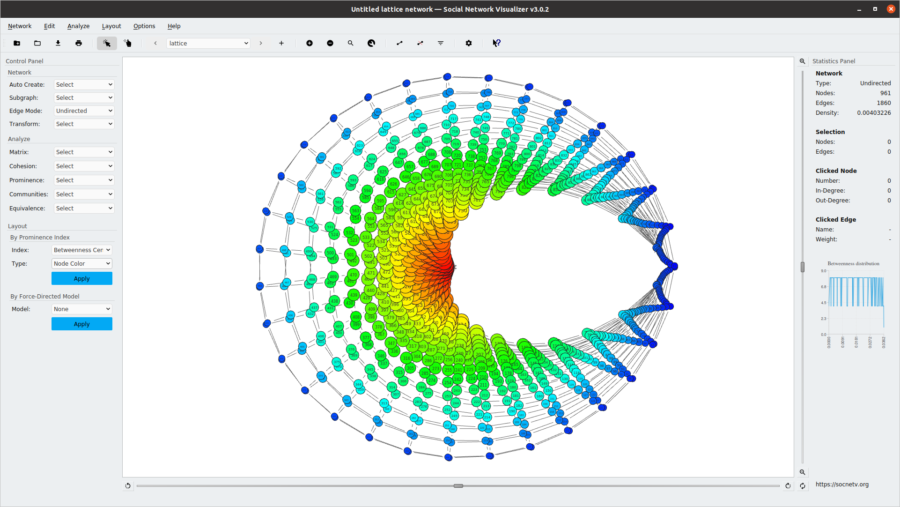

SocNetV 0.70 – the web crawler release :)

June 29, 2009

It’s been only one month since the release of 0.60, but SocNetV version 0.70 is here! This summertime release justifies its existence with two new features, a built-in web crawler and multiple node selection.

The web crawler, based on some older tutorial code I had, is pretty simple software (don’t expect Google power here!), which automatically creates mathematical graphs starting with a given URL, called the seed. As the algorithm crawls that seed webpage, it identifies all the links inside the page and adds them to a list of URLs (called frontier). Then, all the URLs from the frontier are recursively visited. In this process, a network of pages (nodes) and links (edges) is being developed allowing the researcher to study and visualize network properties, such as centralities, etc.

At the moment, the web crawler code is quite immature (i.e. doesn’t recognize framesets) but I hope it will evolve in the future. To test it, go to menu Network > Web Crawler (keyboard junkies, press Shift+C). A dialog will appear – enter the initial web address (seed), the maximum recursion level (how many URLs from the frontier will be visited) and the maximum running time and press OK. Here’s a screenshot of SocNetV crawling http://socnetv.sourceforge.net with betweeness centrality radial layout: (more…)

Share and Enjoy:
  • Digg
  • Sphinn
  • del.icio.us
  • Facebook
  • Google Bookmarks
7

SocNetV version 0.60 says hi!

June 1, 2009

Happy to report that we released version 0.60 of Social Networks Visualizer (SocNetV) on May 27, 2009. This is a major release bringing:

  • native support for GraphML (this becomes out default load/save format for networks),
  • edge filtering by their weights,
  • new node shapes,
  • lots of bugfixes
  • fresh iconset
  • and a bit of geek cream on top: custom background images.

(more…)

Share and Enjoy:
  • Digg
  • Sphinn
  • del.icio.us
  • Facebook
  • Google Bookmarks
5

melux: a custom ubuntu iso creation script!

April 18, 2009

When I was working for the Greek Linux Format, I was making special editions of Ubuntu for the magazine’s DVD. Those were the same distro of course, but with a lot more packages preinstalled. For that purpose, I had written all the useful info and relevant commands inside a text file. Of course, that wasn’t highly efficient, since I had to manually run through (read: copy/paste) all the commands again and again for every new custom Ubuntu image. So, I was always thinking that I should assemble and automate all those commands in a nice Bash script, but I never really tried it. This week, I finally decided to build that script and share it with everyone. So, I hereby give you Melux 1.0 (see full code below). (more…)

Share and Enjoy:
  • Digg
  • Sphinn
  • del.icio.us
  • Facebook
  • Google Bookmarks
9

Αναμνήσεις: BBS & Ansi Art

March 30, 2009

Αφορμή γι’ αυτό το post ήταν ένα σχόλιο που ξεκίνησα να γράφω στο forum του Linux Format σε ένα thread με τίτλο «star wars στην κονσόλα». Ξεκινούσα κάπως έτσι: «Και τις παλιές καλές ημέρες των BBS …» όταν συνειδητοποίησα ότι θα ήθελα να κάνω ένα …γενικότερο blog post αφιερωμένο σε αυτήν την όμορφη φάση  στην οποία συμμετείχα κι εγώ (Ctr+F: Power. A, κοιτάξτε και ποιος νυν γραμματέας του HELLUG είναι από κάτω μου – γειά σου jimmy!).

Τι ήταν οι BBS και τι τα ANSI γραφικά;

Πρώτα απ’όλα να είμαι ειλικρινής. Τα έχω ξεχάσει ΟΛΑ, οπότε πολλά από τα παρακάτω μπορεί να είναι ανακρίβειες. Είναι ότι θυμάμαι και ότι θυμήθηκα με τη βοήθεια του Γούγλη…

Λοιπόν, BBS σήμαινε Bulletin Board System (ή ελληνικότερα «βάσεις») και ήταν PCs (γκούχ γκουχ και Amiga θα έλεγε ο Κωνσταντινιάδης) και όπου συνδεόμασταν συνήθως 1-1 μέσω πάναργων modems. Μιλάμε για εξωφρενικές ταχύτητες: έβλεπες πραγματικά τα δεδομένα να έρχονται γραμμή προς γραμμή .

Αυτές οι βάσεις έτρεχαν πάνω σε κάτι συστήματα που τώρα μου φαίνονται εξωτικά: κάτι  Remote Access (το έχω ακόμα στο σκληρό, δεν ξέρω καν πως το λειτουργούσα!),  BinkleyTerm,  και FrontDoor, κάτι Telix για συνδέσεις κλπ κλπ. Ήταν η εποχή  των ανήλικων Sysops, όπου τα ASCII γραφικά είχαν περάσει σε άλλο επίπεδο, λέγονταν ANSI γραφικά (ή «ASCII extended») με 256 σύμβολα και δυνατότητα …έγχρωμων γραφικών (16 μπροστά και 8 στο φόντο!) στη γραμμή εντολών του DOS μέσω ενός driver (ansi.sys). BTW, τω καιρῶ εκείνω δεν υπήρχε κάτι άλλο. Για editor το καλύτερο ήταν ο THEDRAW μέσω του οποίου φτιάχναμε την welcome screen (logon.ans) και την έξοδο (logoff.ans) της «βάσης» μάς. Αυτά τα γραφικά έφτασαν σε τόσο ψηλό  επίπεδο, που αν κοιτάξετε λίγο τις παρακάτω εικόνες θα σκεφτείτε αμέσως την τέχνη του «γκράφιτι». (more…)

Share and Enjoy:
  • Digg
  • Sphinn
  • del.icio.us
  • Facebook
  • Google Bookmarks
3

Crayon Physics (and what about an open-source Crayon-Physics?)

March 7, 2009

Crayon Physics is a fascinating 2D physics sandbox/game, which came to my attention today when I was reading  Sarinee Achavanuntakul’s blog entry about the sad HotU (Home of the Underdogs) demise and, more than welcomed, revival.  Sarinee mentioned Crayon Physics Deluxe in her blog post, and I checked it out. What I saw in the flash video was jaw-dropping. Crayon Physics  is not just an indie game, but imho a great educational tool in which you really get to experience “what it would be like if your drawings would be magically transformed into real physical objects”. I wonder, is there an open-source counterpart for creative use of physics?

See the video (2.50min, Vimeo):

Crayon Physics Deluxe from Petri Purho on Vimeo.

Update: There is a wonderful open-source alternative, called Numpty Physics, with lots of different levels. Thanks Mike, for pointing to it.

numptyphysics

Also, nuclear mentioned a physics engine, called chipmunk. Check it out.

Share and Enjoy:
  • Digg
  • Sphinn
  • del.icio.us
  • Facebook
  • Google Bookmarks
5